
By Robert Michael Pyle
Butterfly survey in the Willapa Hills of Southwest Washington has largely been shut down because they are almost all privately owned forest land, and the timber companies have gated nearly all their roads in recent years. The companies used to invite the public onto their lands and even published a recreation map for their use. Thea and I explored those logging roads and the remaining habitats they accessed for many years, so their gating has been more than frustrating. Recently, our wonderful Cathlamet town librarian, Miss Vicki (Vicki Franklin), tipped me off to a logging road that still runs ungated deep into the hills. My friend Andrew Emlen, a fine naturalist who lives at the end of Skamokawa’s Middle Valley, confirmed that the old Alger Truck Trail, crossing mostly DNR land, is not gated for quite a way. I was de-lighted to hear it.
So on August first and again on the second, I plumbed that route for the first time in many years. At the point where the only guardrail in the whole of the Willapas used to be, the route splits. I went right, steeply down to the South Fork of the Grays River. The old green steel bridge we used to cross to drive along a beautiful stretch of the South Fork is now closed and tank trapped. From a path up the berm, one can still see the river. A little before there is a marsh with some standing water, a rarity in these hills with very few water features besides creeks, rivers, and rain. Reed canary grass has come in, but there are also lots of sedges and rushes, and I’ll just bet a colony of Dun Skippers (also known as the Sedge Witch) lives in there. Cedar Waxwings were delightfully flycatching over the marsh, and a Pygmy Owl called for a few minutes on the far side—the only owl I’ve heard around here for years, aside from Barred Owls. Also, a Pileated Woodpecker. The woods around the marsh have some age to them, and there were several patches of maturish forest on the way, among recent plantations and clearcuts. Much as we struggle with them over legacy forests, DNR goes a little lighter on the land than the corporations that control (and gate) all the rest.
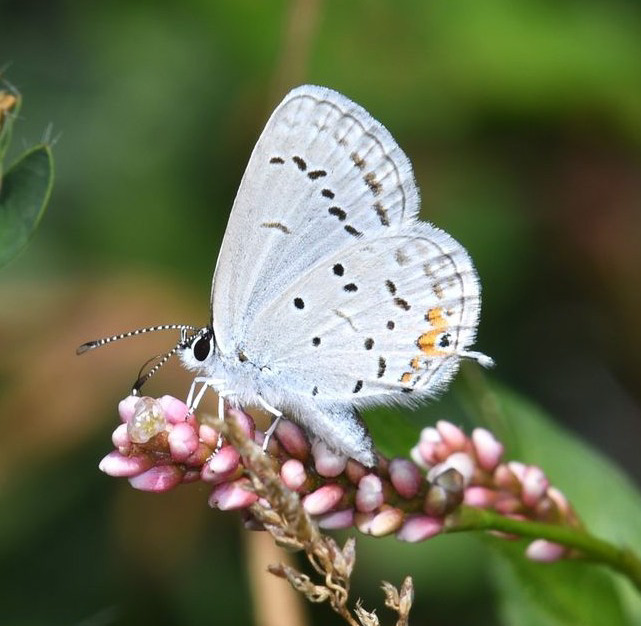
After that, I wound back up to the high spine of the hills and followed the Grays River Divide to the west. At the high point there was a far view south. Andrew says you can see Tillamook Head from there, but I’ll have to take his word—there was a marine layer over the coast. But what I could see was Nicolai Mountain across the river in Clatsop County, which is significant because Mike Patterson has found Eastern Tailed Blues (Cupido comyntas) there, among other localities in Clatsop. I have long wondered why this species should occur south of the Columbia, but not on the Washington side of the river. Now, up there on the Divide, along with Hydaspe Fritillaries, Margined Whites, and Mylitta Crescents, I spotted a really eensy butterfly and managed to net it: a female tailed blue! A little way along, I caught three more.


Our usual ones are Western Tailed Blues, Cupido amyntula. But these occur at low elevation on Giant Vetch and American Vetch, flying in the spring to early summer. These tailed blues, all females, were flying later, were tinier and spottier than the Westerns, and had multiple aurorae, the minute orange patches beside their tiny tails (yet they work—all were bird-struck at the tails!). They were apparently subsisting on the White Clover that underlay the Pearly Everlasting and Goldenrod of the clearcut verge. (In Colorado, I found that White Clover is a well accepted host of C. comyntas.


So these appeared to be the second western Washington location record of which I was aware for the Eastern Tailed Blue, and both a Wahkiakum County and Willapa Hills first record. They might be introduced, as might the entire species in the West, although Andy Warren doubts it. But then, much of the flora here is exotic too.
It seems you can’t have a great day out without a flaw, and today’s was dropping the fourth specimen—the freshest—as I tried to paper her. I know I will never have the patience for CSI, as I only searched for half an hour on my knees (with the help of two sticks to get down and especially up) and a pillow for my knees. Her folded mole-gray wings were the same color as the gravel. Pride doth goeth…! So she is for the ants Still, as I dropped back down to the valley, the highway, and home, I felt replete with an exciting find and a decent day’s list for Willapa: sylvanoides, rutulus, marginalis, echo, comyntas, hydaspe, mylitta, pegala, and an honorary butterfly, the orange underwing moth Dasyfidonia avuncularia, The Uncle. Ten species: not bad for these always subtle hills.
The next day, August 2, I went up again, determined to ascertain the record and to try to find males. Cloudy at first, but just as Weather Underground said it would, the day brightened into the afternoon and was clear by three. I reached the discovery site just as some sunshine and warmth arrived as well, and quickly collected the three males I’d come for, across the road from where the females were taken the day before. Seeing the males as well, I was quite sure these were indeed Eastern Tailed Blues, an exciting find. I saw more of each, but didn’t want to further tax this tiny population. A nice little voucher series of three pairs will suffice for documentation. Though I expect they are tough, for such teensy and delicate butterflies: the photos on GoogleEarth and Google Maps show logging equipment parked on the very habitat where I found them, one year ago! Other butterflies today, cooler and breezier than yesterday, were much the same, plus one nice little California Tortoiseshell basking in the road.

Before heading out the way I came, I explored the road all the way down, down, down almost to the main branch of Gray’s River at the Fossil Creek Road. I knew it would be gated and I’d have to climb all the way back up, but I wanted to see how far I could go. When I finally hit the gate, I was only about three miles from my house! Then I got gated out again on another deep dive down a steep little road I thought might actually come out, very near KM Pass, a few miles east of here. But that’s okay; it’s all about exploring the hills, which I haven’t been able to do for years—so thanks again Miss Vicki & Andrew! Vicki had gone up in search of Red Huckleberries. Speaking of berries I got into some excellent ripe Thimbleberries up there, and also Black-caps—the rarest of our local Rubus species, and my favorite. I scarfed quite a few of each. Red Elderberries beautifully backdropped the roadsides. Oh, and I should include that the number of people I encountered both days, after I left the pavement, was zero. Another good thing about our crapped out, shaggy little hills.
So what about the status of the Eastern Tailed Blue in Western Washington? It was first discovered by Dan Nelson in the Shillapoo Wildlife Area by Vancouver Lake, Clark County, on June 3rd, 2018, where I joined Dan to spot it on June 7th. I’ve since learned that, operating on a tip from birder Dave Hayden, Keith Brady found and photographed it on August 1, 2021, on the Kiwa trail, Ridgefield National Wildlife Refuge, Clark County, and for the succeeding two years. With this in mind, on August 9 I sought suitable habitat for the butterfly around the Woodland town dike, just three miles north of the Ridgefield locality but in Cowlitz County. I had no luck but did spot some White Clover stands that call for additional searching.
Then two days later, in a run of very hot days, I drove to the gate at the end of the Elochomon Valley Road out of Cathlamet, seeking Leto Fritillaries on thistles. Everything had dried out and there was very little nectar, and just a Wood-land Skipper and Margined White or two in evidence for butterflies. But there was a patch of Birdsfoot Trefoil still in bloom, underlain by a little Red and White Clover. I poked about and soon spotted the flash of minute blue wings. Of course it was the Eastern Tailed Blue. After a couple of misses I netted one male. I spotted a few more, but the one voucher was adequate to the purpose. Now we had Cupido comyntas confirmed from both major drainages of Wahkiakum County, the Grays and the Elochomon, on both sides of the Grays River Divide. This site is very near Pacific, Lewis, and Cowlitz counties, so the butterfly seems highly likely to occur in each of them as well as Wahkiakum.
So we now have a nice little archipelago of SW WA records, resolving the longtime mystery of the species’ apparent absence from this side of the Columbia. And what larval resources do they use? I found it over White Clover (Trifolium repens) and near Red Clover (T. pratense) and Birdsfoot Trefoil (Lotus corniculatus), which Acmon Blues use as a larval host as well as several British blues, where the plant is native. Keith Brady’s Ridgefield photos show White Clover and the Lotus, and nectaring on knotweed and mint, and he says it darts out of and retreats into Reed Canary Grass. So watchers in SW Washington should check out all these plants where they co-occur. Clearly, the Eastern Tailed Blue is good at adapting to disturbed conditions. I think it likely that it has followed the logging roads, and logging, into the hills.
We will learn more about this bright blue mite in years to come. Meanwhile, it’s good to know that we have another Western Washington butterfly to watch for.


G’num2025Vol26No3

Robert Michael Pyle
Founding Member, Noted Lepidopterist, Founder of the Xerces Society, Author of more than 20 books
Feature photo of an Eastern Tailed Blue by Keith Brady